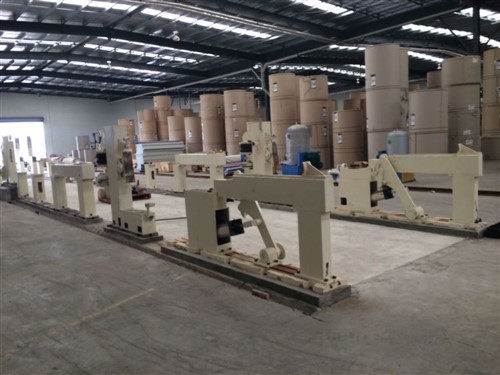
What is Writing and Printing Paper Machine?
The Writing and Printing Paper Machine is a high-speed machine that produces paper of various grades and sizes. It features advanced technology such as a pressurized headbox and an efficient wire part for optimal paper formation and drainage.
Professional Team
Xinhe is a comprehensive enterprise serving in papermaking industry and specializing in design, engineering, research, manufacturing, installation, commissioning and contracting of papermaking machinery and turn-key projects.
Our Product
Xinhe paper machines can be used to produce all kinds of tissue paper, printing paper, packaging paper and specialty paper.
Customer Service
We prioritize open communication to address our clients' specific requirements and deliver personalized solutions.
Technical Support
Our team of experts is available to assist with troubleshooting, answer technical inquiries, and provide guidance.
Ensuring quality control in the paper manufacturing process is essential to produce high-quality products that meet customer expectations. Here are some steps that can be taken to ensure quality control in the paper manufacturing process:
Raw Material Quality Control
Raw materials used in paper manufacturing should be checked for quality before being used. The quality of wood pulp, recycled paper, and other raw materials should be checked for impurities, moisture, and other factors that can affect the quality of the final product.
Process Control
The manufacturing process should be monitored to ensure that it is within the acceptable range of parameters. Control charts can be used to track key process parameters such as temperature, humidity, and pressure, and deviations from the standard parameters should be addressed promptly.
Quality Testing
Quality testing should be performed at various stages of the manufacturing process to ensure that the product meets quality standards. Tests may include tensile strength, tear resistance, brightness, and other parameters.
Statistical Process Control
Statistical process control can be used to monitor the manufacturing process and detect any deviations from the standard parameters. This can help identify potential quality issues before they affect the final product.
Calibration and Maintenance
The equipment used in the manufacturing process should be calibrated and maintained regularly to ensure accurate readings and prevent breakdowns that can affect the quality of the final product.
Quality Audits
Regular quality audits should be conducted to ensure that the manufacturing process is meeting quality standards and to identify areas for improvement.
It is easy to overlook the impact that paper has on our lives. However, everywhere you turn you see a presence of paper. All books, magazines, invitations, flyers, newspaper, and mail are produced on printing and writing paper.
The main difference between printing and writing paper is its composition. The composition is impacted by the fibers and coating compounds used.
The pulp, often referred to as fiber, can be extracted from wood mechanically or chemically. There are several coating options and each produces a different grade of paper. Writing paper is uncoated while printing paper is coated.
There are a wide variety of printing and writing papers, but they are usually classified as one of four main paper grades.
4 Grades of Printing & Writing Papers
Throughout the United States Printing and Writing Paper is divided into 4 main categories:
1. Uncoated Freesheet – [Example: Copy Paper]
2. Uncoated Mechanical – [Example: Newspaper]
3. Coated Freesheet – [Example: Posters]
4. Coated Mechanical – [Example: Magazine]
A large number of printed products demand a type of printing and writing paper. Though there's a standard for paper production, varied production techniques produce distinct differences and paper types.
Paper Production Process
Nearly 1/3 of unprocessed wood harvested in the United States is used to make paper-related products.
The pulp (fiber) from trees used in paper is extracted chemically or mechanically. Higher quality graphic and specialty papers are produced from chemical extraction, while rougher newspaper fibers are produced from mechanical extraction methods.
Then a chlorine derivative is used to further breakdown the fibers and bleach the paper. Really bright papers have been heavily bleached and are denoted by a higher brightness number. A maximum brightness rating of 100 denotes the most vivid, whitest paper.
Paper coating compounds include clay, protein and calcium carbonate, and are added to influence papers performance, weight, and ink absorbency.
One common misconception about printing is that it's always as simple as clicking "print" on a computer and having a neat stack of paper fresh from the printer minutes later. To get the best details, colors, and results, many professional printing jobs take a little longer to set up and execute properly. This includes offset printing – One of the most stunning but also misconstrued printing processes.
When we think of the printing process, most of us envision printers embedding an image directly onto paper. Offset printing works differently and gets its origins from lithography, a printing process that originated in 1796 as a cost-effective method of printing theatrical works. While offset printing, or modern lithography, has evolved significantly since the 18th century, it still operates on one simple fact – Oil and water don't mix.
During the offset printing process, the ink rollers on the printing press transfer from the image file directly onto a printing plate. Once plated, the image areas are ink receptive and water repellant, and the non-image areas are water receptive and ink repellant. This ensures that the non-image area remains ink free. From the plate, the image is transferred onto a flexible rubber sheet on the press. As the paper passes through the press, between the rubber sheet and the impression cylinder, the image is then transferred onto the paper. This printing process is called "offset" because the ink is offset to the rubber blanket and then to the paper.
Although offset printing may seem old-fashioned, the clear, crisp lines and details on offset jobs often take a level of preciseness that can't be duplicated through other printing methods. With offset printing, we can achieve optimal results at high volume and speed. But even though the offset process runs with maximum efficiency once it's set up, setting up an offset job does take a little more time to perfect. Getting the plates, rubber blanket, and image just right in the printing press is important to us, and for that reason, a little more lead time may be necessary to get the job done right.
Large quantities can be printed at a lower cost
Unlike other printing methods, the more you print, the more cost-effective it is
Jobs can be accomplished in either black or CMYK colors
Offset has the highest possible printing quality with flawless detail and color balance
Flexible options with paper types and custom finishes
The expected turnaround time for an offset job depends on the specific details, but we will discuss this with you during the planning process and work with you directly to make sure you get what you need, when you need it.
Offset printing typically works best for projects that require a large run. What qualifies as a large run can vary by product based on how many pages we can arrange on a single sheet of paper. For example, a large run of books could be anything exceeding 500 pieces or 64 pages, as books contain many pages. A large run of flyers would likely be much larger, as a flyer only consists of a single page. As a rule of thumb, if you're interested in offset printing, ask your printer about the job you're looking to print. We can guide you to the most economical and best-suited method for your job.

Types and Advantages of Paper Machine Headbox
Normally the headbox is categorized into three types such as open type, air pad type and hydraulic type. Among them the hydraulic headbox is designed for a high speed modern paper machine (above 300 m/min) whereas open headbox is used in low speed paper machine. In hydraulic and Air pad headbox , the discharge velocity from the slice depends directly on the feeding pump. For this reason they commonly known as pressurized headbox. The hydraulic headbox has no air pad, it is fully enclosed.
In case of air pad headbox a pond level is maintained. Above the level it contains pressurized air. The stock level is known as head, which is controlled by air pressure. The head determines the slice jet speed. It contains two or three Rectifier roll.
Moreover multi-layer hydraulic headbox is available which is designed for making tissue paper and lightweight containerboard. Each layer has different furnish compositions and delivery system.
Functions
The headbox has many functions among them the following three functions are very important.
It spread the stock uniformly along the width of the forming fabrics.
It provides the stock at constant velocity according to the paper machine speed.
Create control turbulence and uniform suspension to eliminate fiber gathering.
If the headbox does not perform these functions correctly then the quality of the paper will be greatly hampered.
Benefits
You will get many benefits from the well constructed headbox. It can improve formation and paper quality, reduce number of breaks and downtime, fewer pinholes, dirt spots, improve runnability, increase machine speed, stabilized paper caliper, improve water removal, and reduce chemical cost. All these properties are achievable, if the CD basis weight profile, main fiber direction, uniform formation, flatness, etc. are perfect.

What Materia is Are Used in Commercial Printing?
As a constantly evolving industry, commercial printing often adapts to new methods and innovations in production. This means that companies use several methods and various equipment to produce their prints. So, let's dive in and explore the materials used in commercial printing!
Printing Press Machine (printers)
The most important equipment a commercial printing company needs is printers. There are different types of printers depending on the commercial printing process involved. Commercial printing utilizes the following types of printing press machines:
Offset printing presses
Digital printers
Large format printer
With the appropriate printers, commercial printing companies offer high-quality printed products to their consumers. Because commercial printing is done on a larger scale, it requires specialized ink and paper.
Printing Press Ink
To achieve high-quality printed material, printing companies must use quality press ink. With innovations in commercial printing being introduced more often, several printing press inks exist today.
The printing press ink used includes offset, digital, and liquid inks for packaging.
One to six colors
PMS process
Flood coats
Special varnishes
Offset Inks
Offset inks were the first significant invention in commercial printing, replacing letterpress ink. Offset ink presses significantly streamlined the printing process. There are three main types of offset inks: sheetfed, headset, and cold-set.
Sheeted inks are present in magazines and reports, and since the sheets are put into the press, they can be thicker substrates, allowing for the production of folding cartons. Sheetfed presses can run up to 20,000 sheets per hour.
Cold-set inks are the primary inks for newspapers, consisting of carbon black and binders. But cold-set inks also include color pigments when needed. On the other hand, headset inks are the main ones for magazines and are similar to cold-set inks.
Offset inks are usually oil-based and require drying after printing. But, companies are shifting towards renewable resources like linseed oil or soy-based inks. This is due to the increased demand for sustainability.
Digital Inks
With digital printing as the fastest-growing sector, digital inks have become highly sought-after. Digital inks can be used in digital and hybrid presses. There is a range of digital ink colorants available for digital printing.
Even though dyes were initially used for most digital printing, pigments are more common today due to their lightfastness.
Liquid Inks For Packaging
In commercial printing, we also use inks in packaging. Dominant technology for packaging is liquid inks, mainly flexo and gravure inks. Both flexo and gravure are roll-to-roll presses. Depending on the application, liquid inks can cover water-based, solvent-based, and UV-based technologies.
The resin type and additives are the main differences between liquid and paste (offset) inks. There are many resin types including, acrylic, polyamine, and nitrocellulose, which are among the most commonly used. In contrast, paste inks incorporate hydrocarbon resins.
Cutting system
Printing companies use sheets in the printing process, which means there will be lots of cutting included. But, due to the volume of work in commercial printing, manually cutting prints is not feasible.
This is why cutting systems are a must for printing companies. There are manual, semi-, and fully automatic cutters. Automatic cutters significantly increase the cutting speed and can be set to cut with incredible precision.
Binding equipment
Only some print shops offer binding, and most are outsourcing the printing work. We take pride in providing our consumers with every service involved in commercial printing, from start to finish.
Perfect binding
Plastic-coiling
Comb binding
Xinhe provides professional papermaking customers all over the world with equipment and services from stock preparation and paper making to converting and finishing, including paper machinery, stock preparation equipment, converting equipment, key machine parts, spare parts, papermaking consumables, equipment rebuild, project engineering, turn-key project, start-up assistance and commissioning. Xinhe paper machines can be used to produce all kinds of tissue paper, printing paper, packaging paper and specialty paper. Xinhe also supplies customers with high-quality key parts, spare parts and papermaking consumables, such as headboxes, steel dryers, rolls, doctor blades, felts, wires and chemicals.

As one of the leading packaging paperboard machine suppliers in China, we warmly welcome you to buy high-grade packaging paperboard machine made in China here from our factory. All customized products are with high quality and competitive price.
Corrugated Box Board Machine, Duplex Paper Board Machine, Packaging Paperboard Machine